Gemini Live
2024
Shaped Gemini Live's product roadmap through diary study


Problem area
Initial launch of Gemini Live
Google was preparing to launch Gemini Live, a new conversational voice AI, and needed to understand how real users experienced it in everyday life. I joined a cross-functional team to run a 2-week unmoderated diary study with 34 participants, capturing how people naturally integrated Gemini Live into entertainment, learning, and personal conversations.
Research Goals
What the team needed to learn
First Run and Long Term Experience
How users' perception of Gemini evolved over 2 weeks
Conversation Flow
Assess how well Gemini Live supports complex conversation topics including acting as a coach and navigating personal conversations with users
My role
What I focused on
Coding Data
Applied coding frameworks to transcripts and session notes to identify patterns
Findings Documentation
Created findings presentation and strategic recommendations for product team
Participant Management
Provided one-on-one support to resolve questions about study instructions
Use Case 01: Activating gemini live
How did users react to setting up Gemini Live
Small UI Details Created Big Friction
While reviewing activation videos, I noticed participants repeatedly struggling with the same interface elements. I coded these friction points:

Challenges Identified
Icon Visibility Challenge
The "Live" button lacked distinctiveness, participants suggested color gradients, motion effects, or more prominent visual cues to make it stand out from other interface elements.
Status Uncertainty
Users couldn't confidently tell when conversations were paused, often seeing audio waves move even when supposedly on hold, creating confusion about system state.
Quality of voices
Some participants found the voices too robotic or not appropriately toned, with some describing them as too sassy or too friendly.
Participant Quotes
Icon Visibility Challenge
"I think the small button may not stand out to users who don't have prior instructions"
Status Uncertainty
"I can't tell with hundred percent certainty that the hold button is working, I see the waves moving, and so maybe it is listening to me.."
Quality of voices
Some of the voices sounded a bit too robotic and not natural-sounding.
Use Case 02: Conversations about entertainment topics- books, movies, TV
How can Gemini Live hold natural entertainment conversations without losing context?
After analyzing participant conversation transcripts across books, movies, and TV shows to understand engagement patterns, we found that:
Books: Gemini performed best in conversations about books. Detailed insights without spoilers kept users engaged.
TV Shows: Its responses regarding TV shows were Inconsistent: Newer and niche content led to factual errors, due to training data lag.
Context Loss: Across all entertainment topics, Gemini routinely lost conversation threads during follow-ups, breaking the flow of discussion.
Transcript of Gemini losing context mid-conversation:

Challenges Identified
Popular v Niche Content Divide
Books generated the most satisfying conversations, while TV show discussions were inconsistent, especially with less popular content leading to factual errors.
Context Loss Issues
Gemini lost conversational thread during follow-up questions, such as confusing "Mercedes" the character with Mercedes the car brand during a Count of Monte Cristo discussion.
Missing Visual Cues
Without visual cues like covers or images, participants struggled to stay engaged and wanted links to streaming platforms or purchase options to deepen the experience.
Participant Quotes
Popular v Niche Content Divide
"Gemini said many contradicting things. Initially it said it hasn't heard about Young Sheldon. After a lot of back and forth, it was able to look it up but my questions were incorrectly answered."
Context Loss Issues
"The conversation got derailed in the middle where Gemini didn't remember we were talking about The Office which wasn't ideal
Missing Visual Cues
"I would have wanted for Gemini to show me in the background where to watch the show and an image of the TV show."
Use Case 03: Acting as a coach
How well does Gemini Live support users learning new skills?
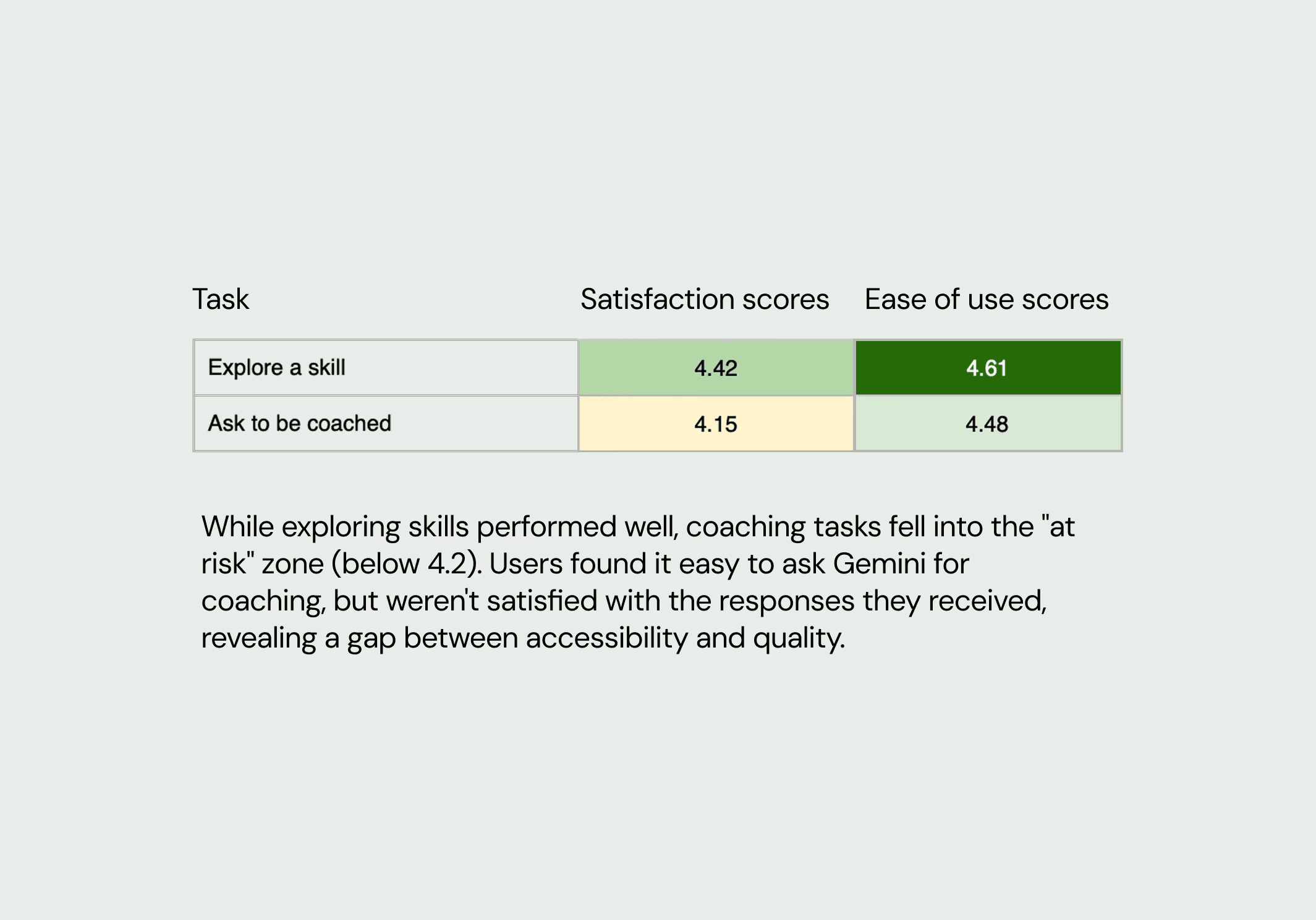
Through coding learning conversations (piano, coding, ukulele), I discovered a mismatch between user expectations and Gemini's output.
Challenges Identified
Skill Level Mismatch
Asking for skill level would make the experience more valuable. Advanced learners were underwhelmed and beginners sometimes found the guidance too complex.
User Expectation Mismatch
Participants expected Gemini to complete learning tasks (like creating resumes, setting up practice schedules) rather than just providing instructions.
Need for Visual Aids
Voice-only explanations became awkward for visual skills like coding or ukulele playing, participants needed demonstrations, not just verbal instructions.
Participant Quotes
Skill level mismatch
"This one was a little more difficult just because I was asking for tips on learning a skill that is typically learned visually and hard for Gemini to explain verbally."
User Expectation Mismacth
"It was a little awkward to have Gemini Live explain coding syntax through conversation as you can't exactly communicate new lines and such."
Need for visual aids
"It can ask us to pick a skill level and give us response accordingly. This can be a global setting or per skill I want to learn."
Use Case 04: Personal conversations with Gemini
How can Gemini Live create natural dialogue about personal challenges?
Through coding learning conversations (piano, coding, ukulele), I discovered a mismatch between user expectations and Gemini's output.

Challenges Identified
Lack of personalised responses
Gemini’s responses were not tailored in a helpful way. Many responses were very standard, such as “be more honest,” which were seen as generic pacifiers and not very useful.
Issues with turn-taking
The turn-taking needed improvement for difficult conversations to be well served. Gemini did not understand the user’s context, resulting in more generic responses.
Participant Quotes
Grasp of nuance
"I really liked the phrasing Gemini used on reaching out to a friend that owes me money. It is a difficult subject to bring up but it made it sound so easy."
Lack of personliased responses
"The conversation felt that it was definitely attempting to be helpful, but in terms of actionable suggestions, I don't think there was much that I wouldn't already think of on my own."
Issues with turn-taking
"Gemini should ask for more context to inspire deeper thinking/finding the most appropriate solution."
Outcomes and Retrospective
What I learned about AI and expectations
This project taught me that unmoderated diary studies require reading implicit signals like tone changes, repeated attempts, and abandon points, not just explicit feedback. I also learned that people anthropomorphize conversational AI quickly, treating Gemini like a friend within days, which meant generic responses felt like personal rejection. My most valuable contribution wasn't documenting what worked but mapping the gap between what users expected, task completion, and what Gemini delivered, instructions. That delta became the roadmap. Working on evolving technology also forced me to distinguish between product bugs that needed immediate fixes and fundamental design questions about what the product should be.

